
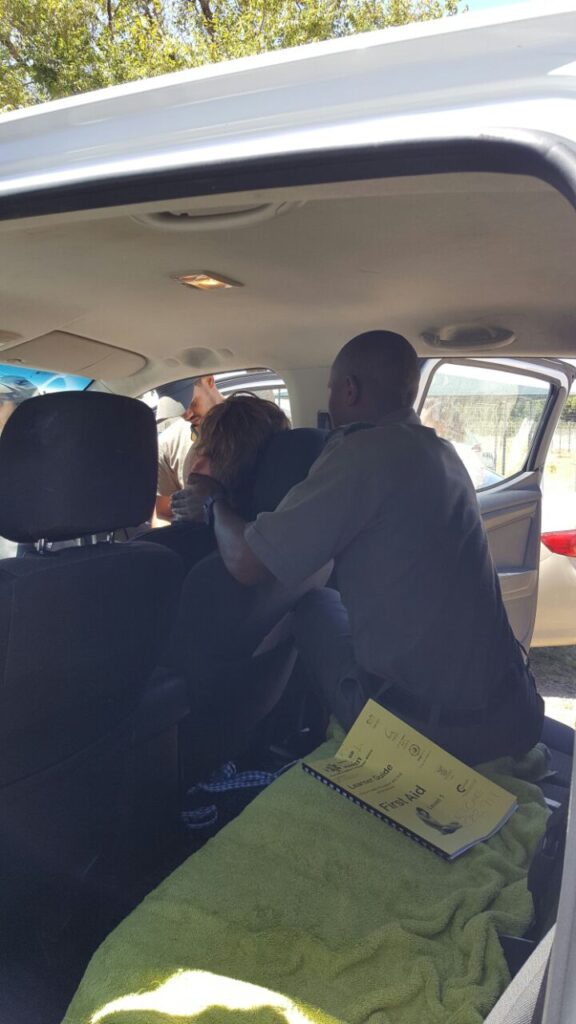

Understanding a First Aider's Duty to Act in South Africa: Legal, Moral and Ethical Perspectives.
Introduction:
A delegate from one of my sessions earlier this year told me about a car accident he had witnessed and how he had pulled over to help the victims. The first responder, who was now enrolled in my class for renewal, asked me what I thought of the scene. He said he had discussed it with a friend who is a nurse, and she advised him to be grateful that he stopped to help. If he had driven by and someone had discovered, he might have been arrested for neglecting to act as a first responder and not providing aid. As a result, the first responder was uncertain as to whether they had a legal "duty to act". We can all agree that it was good idea for him to stop and render aid, but not for the alleged legal reasons described by the nurse. We would like it if first aider did always assist when the incident occurs, but it is undoubtedly a common occurrence that certified first aiders fail to act on scenes, but what are the consequences? The ‘failure to act’ is not limited to first aiders, it does also happen with medical professionals, such as doctors, nurses, paramedics, and other medical professionals, who are often off-duty. The reasons for the failure to act is vast a varied, but fear is a common element, we will examine the reasons later in this blog.
Section 1: Legal Framework
In south Africa there is no specific legislation that mandates a duty to act for first aiders and therefore the possession of a certificate in no way legally obliges a first aider to act. However, there is a moral and ethical obligation to act in some way we will look at that later in this blog. There is also a possibility that your failure to act accordingly, may be met scrutiny under criminal law and it would be left up to the courts to determine if your actions in the given circumstances were reasonably appropriate. The author could not find any examples, in South African case law of an instance where a first aider was found culpable for not assisting a patient in need. Everyone of us has an obligation to assist those in need, the help that you provide is however, based on the your abilities, you may not have the fortitude to deal with a gruesome scene or a scene that pays a heavy emotional toll on your psych. Think of a mother who has witnessed her child in an accident, their emotions often work against their rational thoughts, and prevents them from providing the care the child needs.
In the workplace: The South African Occupational Health and Safety Act (OHSA) places obligations on employers to ensure the safety and health of their employees. If the first aider obtained their first aid certificate through their workplace, their employer might have specific policies or contractual obligations that require them to render assistance in emergencies while on duty or within the scope of their employment, therefore the failure to act on the part of the first aider may have disciplinary consequences.
It is a misconception that South Africa has a “Good Samaritan act” in statute books, but this is not the case and even if it was, as in some other countries, it would not provide the obligation to act as Good Samaritan act serves to protect the provider from litigation and not to compel action. For the professionals, In Section 27(3) of Constitution of the Republic of SA states that no one may be refused emergency medical treatment; along with the national health act, 61 of 2003 which reinforces the right of everyone to receive emergency medical treatment. Based on this the Health Professions Council of South Africa (HPCSA) in a judgment made it an obligation of a practitioner to render assistance. This is still not a legal requirement but rather a stipulation of the HPCSA and therefore the perceived failure to act can attract disciplinary process within the professional councils’ framework. Furthermore, whether this judgement applies to the first aider, who is not registered with the HPCSA, is a topic yet to be clarified and until a precedent is available it would remain so. If we however assume the First aider is obliged to act as the professionals are, there exists limitations to those obligations.
In an entry in the South African Medical Journal (SAMJ June 2016, Vol. 106, No. 6) Professor McQuoid-Mason concludes that “Generally, doctors who are the first to come across injured people at a road accident should stop and render assistance unless they may be exposed to personal danger or injury if they stop, are mentally or physically incapable of rendering assistance, or other medical or paramedical practitioners are already present. Where there is the threat of personal danger to the doctors, they must immediately report the accident to the police and advise them to send protection and call for urgent ambulance assistance. They should remain near the scene until the police and ambulance arrive and check that paramedics are available to stabilise the injured before departing. Where there is the threat of danger, doctors are mentally or physically unable to assist or other medical or paramedical practitioners are at the scene, doctors may or may not be required to stop – depending on the circumstances.” and based on this; If doctors have the right to make judgments on their personal safety one would likewise expect that the first aider too can withhold action for the same reasons. An argument can also be made that the first aider is also less experienced and is more likely to misjudge the scene and therefore the fear of rendering assistance is higher. Even if the first aider fails to provide care to a patient who allegedly committed a crime, perhaps to ‘Punish’ the patient, even so; there remains no legal obligation to provide aid, and arrest/criminal process is extremely unlikely, although, civil proceeding may ensue.
Section 2: Common Law Duty
While there may not be a statutory duty, there is a common law duty that can apply. Common law in South Africa acknowledges that individuals have a general duty to act reasonably and provide reasonable care to assist in situations where their assistance can prevent further harm or save lives. This duty may be judge against the likelihood that somebody with similar training and experience would act in the same way. This ‘reasonable man test’ is limited in determining duty to act, as there is no way to consider the feelings of the provider or the ‘mood’ of the scene, so can we really consider the response to the posed question; ‘what would you have done?’. Can we really ask a person who was not there to say what they would have done, when they did not experience the scene as the defendant did.
Section 3: Moral & Ethical Considerations
You will never forget the first time you save a life, nor the first time you don’t. unknown
You will never forget the first time you save a life, nor the first time you don’t. unknown
Not all people have the same morality standards, but most people tend to feel bad if they did not help and they may after the fact try to justify to themselves the reason to not render aid, they may or may not have a legitimate reason and thus may weigh heavily on their conscience. Some may even render help because their moral standards dictate it to them, they may do this even if it unsafe to do so. The lack of legal conscripts in the duty to act places the obligation to act in the ethical realm, and this can allow for subjective opinions on whether the first aider should act or not. It is expected by society for the first aider to act, as we see at school and social events, when an injury occurs one hears the shouts of “First Aid!”, calling for the first aid providers to attend, perhaps because they (caller) does not want the responsibility of dealing with the patient themselves. If you have achieved a first aid certificate it sets an expectation that you are provide first aid care when called upon, ethically you are required to help.
Section 4: Balancing Safety and Action
Nobody can expect a provider the put themselves in harms way the provider has to use their best judgment and decide whether to help or not, based on the information they have on-hand.
Many years ago, I was taking my daughter out to a movie, and on the way, I came across an incident where the patient was lying on the shoulder of the highway behind his vehicle, at this time I did not know the nature of the emergency. I stopped my car on the on ramp to the highway, thinking it was a safer prospect than on the highway itself, I told my daughter to stay in the car and I stopped to give assistance. When I got to the patient, I found that the incident was an attempted hijacking and the patient had suffered a gunshot wound to the chest cavity. The incident had just occurred no more than a minute before I happened on the scene and unbeknown to me, the hijackers had just ran away into the bushes on the side of the highway. This horrified me, my daughter was sitting in my car not far away from the direction to which the hijackers ran. In hindsight perhaps I should not have stopped, but rather make sure the emergency services were notified. I have now made myself a policy; I am more reluctant to stop if I have my kids in the car with me. I will consider stopping if I was alone or with another adult who is willing to take a risk, but I will always make sure that EMS knows about it. Calling for help can fulfil a duty to act.
Section 5: Conclusion
In conclusion:
• There exists no legal statute that compels a first aid certificate hold to render assistance.
• Certified first aiders hold themselves morally responsible to render aid.
• People expect that first aiders will help so they have an ethical responsibility to act.
• Safety always comes first.
• Assist the patient physically or emotionally within your capabilities.
• Make sure the emergency services are notified.
• The least one can do is call for help.